Which Local HVAC Companies Employ Certified Indoor Air Quality Inspectors in Butler–Warren?
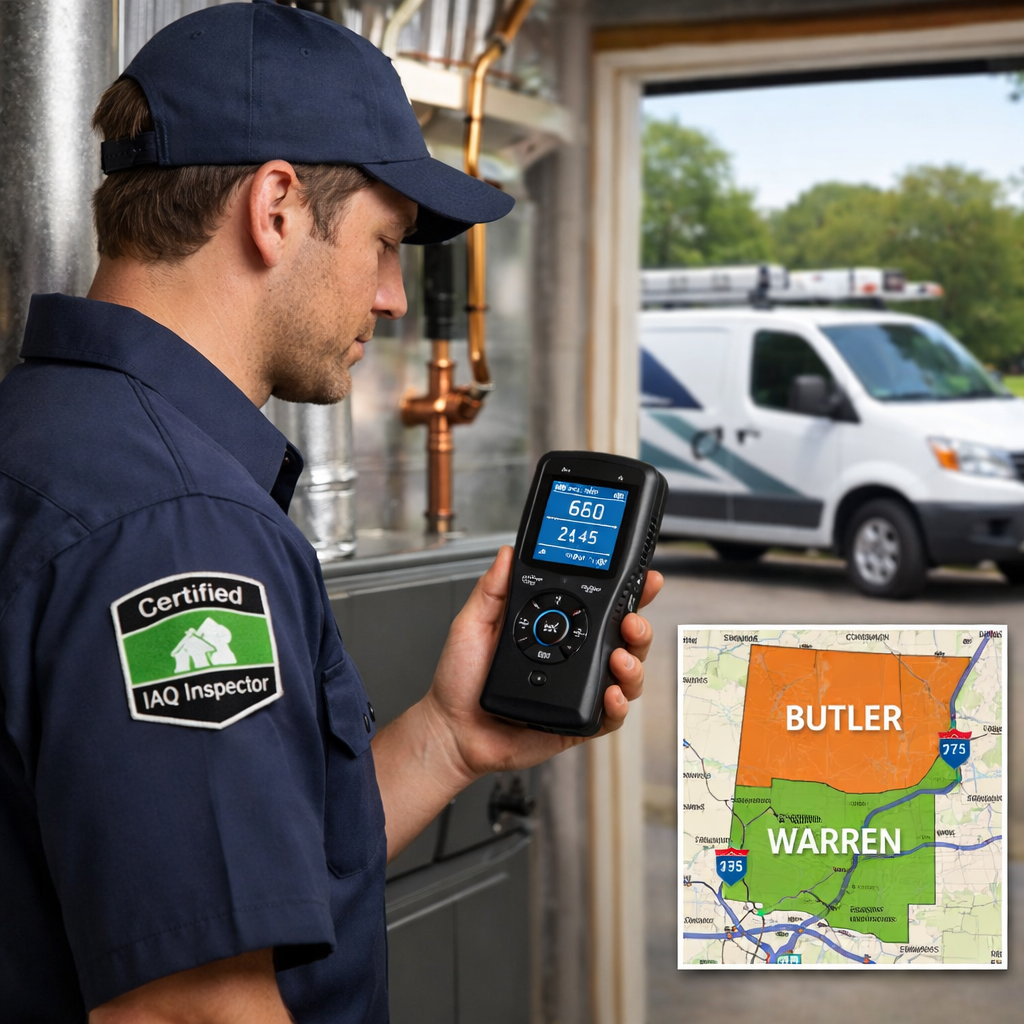
Which Local HVAC Companies Employ Certified Indoor Air Quality Inspectors in Butler–Warren?
Indoor air quality (IAQ) matters in Butler and Warren counties because most people spend about 90% of their time indoors, and indoor air can be more polluted than outdoor air, especially in tightly sealed homes and workplaces (per state air quality research). While some Butler County HVAC and Warren County HVAC providers promote indoor air quality testing, there’s limited public proof tying named, certified IAQ inspectors to specific local employees. Here’s what we can confirm: organizations like the International Certification Board (ICB) maintain public registries of certified professionals, and credible HVAC employers may have certified specialists on staff—but you should verify every claim through registries, sample reports, and IDs. Below, we explain what “certified” means, how to verify credentials, and which local companies to contact with the right questions. If you prefer a guided path, AC Repair Advisor can help you verify claims before you book.
What certified IAQ inspector means
A certified IAQ inspector is a professional who has completed formal training and passed an exam in indoor air sampling, building diagnostics, ventilation assessment, pollutant identification, and reporting to recognized standards (such as ASHRAE methods and the certifier’s protocols). Reputable certifiers maintain searchable registries so you can confirm active status in minutes using the ICB Certified Professionals directory and referenceable ASHRAE Journal research indexes.
Why it matters: people spend most of their time indoors, and indoor air can harbor pollutants like radon, volatile organic compounds (VOCs), mold spores, particulates (PM2.5/PM10), and combustion byproducts. Qualified inspectors help prioritize fixes that improve health, comfort, and energy performance.
What certified IAQ inspectors do:
- Design a sampling plan that reflects your building’s size, use, and concerns.
- Use calibrated instruments for CO2, temperature, relative humidity, VOCs, and particulates; add-on tests may include mold sampling and radon testing.
- Interpret results against recognized guidelines and standards; explain confidence limits and variability.
- Recommend remediation and HVAC strategies (ventilation, enhanced filtration, source control, UV-C, moisture management).
- Validate outcomes with follow-up testing.
How to verify IAQ credentials in Butler and Warren
Use this 5-step checklist with any Butler–Warren HVAC company offering IAQ assessment. AC Repair Advisor can complete these checks on your behalf.
- Ask for the inspector’s certification type, ID number, and expiration date.
- Cross-check the credential in the certifier’s public directory (start with the ICB Certified Professionals directory).
- Request a sample IAQ report from a similar local job that references recognized methods or standards (see ASHRAE Journal research indexes for ventilation/UV guidance).
- Confirm scope: Which pollutants/parameters are measured (mold, radon, VOCs, PM2.5, CO2, humidity), and what instruments and labs are used.
- Verify they carry insurance, hold required licenses, and that their methods acknowledge pollutant variability across time and space, consistent with Pennsylvania Department of Health IAQ guidelines for schools.
Verification quick-reference:
| Verification item | What to collect | Where to confirm |
|---|---|---|
| Certification status | Certifier name, credential, ID, expiration | Certifier’s registry (e.g., ICB directory) |
| Methods/standards | Sample IAQ report citing methods/limits | Inspector’s sample report; ASHRAE research indexes for context |
| Scope & instruments | Pollutant list, instrument models, calibration dates | Proposal; calibration certificates |
| Insurance & license | COI (liability), state/local license number | Insurer, state/local licensing board |
| Reporting quality | Clear findings vs. references; prioritized actions | Sample report; client references |
Certification types to ask about
Not all credentials are equal. Use these as conversation starters to align services with your needs (testing vs. remediation vs. HVAC optimization).
| Certifier/credential | What it validates | Where to verify | Typical scope |
|---|---|---|---|
| ICB (IAQ-related credentials) | Competency in testing, diagnostics, standards-based reporting | ICB Certified Professionals directory | IAQ assessments, ventilation checks, post-remediation verification |
| NATE (HVAC technician certification) | HVAC installation, service, performance fundamentals | Company-provided certificates; NATE ID if available | Signals technical proficiency; not an IAQ inspection license |
| NADCA (A/C duct cleaning) | Duct cleaning and contamination control best practices | Provider’s NADCA documentation | Duct cleaning and hygiene; may complement IAQ fixes |
| State/lab-specific (radon, mold) | Jurisdiction-specific compliance and lab protocols | State radon/mold registries; lab accreditations | Radon testing/mitigation; mold sampling/remediation per state rules |
Definition to keep in mind: NATE (North American Technician Excellence) is a nationally recognized certification for HVAC technicians that validates knowledge of installation, service, and performance. It’s not an IAQ inspector license but often signals a strong technical baseline.
Local HVAC companies to contact for verification
Scope note: Public sources do not conclusively tie named IAQ inspector certifications to specific employees in Butler–Warren. Use the verification checklist above to confirm current credentials before booking, or ask AC Repair Advisor to verify them for you.
Butler Heating & Air Conditioning
- Signal: The company emphasizes training; reports indicate the entire technician staff are NATE-certified and the firm operates an in-house sheet metal shop and public showroom—trust signals of established operations (industry reporting).
- Ask: Which team member holds an IAQ-specific certification? Please share the credential type/ID and a sample IAQ report referencing ventilation/filtration guidance informed by ASHRAE methods.
- Verify: Cross-check the named professional in a certifier registry such as ICB’s. Confirm that instruments are calibrated and reports include actionable recommendations.
Canady’s Heating, Air & Plumbing
- Signal: Recognized as an active regional HVAC employer in trade coverage, suggesting the staffing depth to support IAQ-related services.
- Ask: Do you employ any certified IAQ inspectors today? Provide names, certification IDs, pollutants tested (e.g., VOCs, PM2.5, CO2, humidity), and the reporting standards you follow.
- Verify: Request a recent sample IAQ report and confirm credentials in a public directory. Ensure the scope includes instruments and quality controls.
High Efficiency Solutions
- Signal: Founded by Dustin Ebersole with a training-first culture, hiring and mentoring technicians “from the ground up,” and attention to safety and efficiency trends—conditions supportive of IAQ competency building.
- Ask: Which technicians hold IAQ-specific certifications? Please provide certificate copies/IDs and a recent Butler–Warren project report.
- Verify: Confirm active status in the certifier directory and that testing aligns with ASHRAE-informed methods; make sure recommended solutions are measurable.
Res-Com Heating & Air
- Signal: Cited as an active employer with community recognition—useful but not proof of IAQ credentials.
- Ask: Who performs indoor air quality testing? What certifications do they hold? Which instruments and labs are used? Do reports include remediation pathways (ventilation, enhanced filtration, UV-C, moisture/radon/mold controls)?
- Verify: Confirm in public credential directories and request references from similar Butler or Warren County projects.
What to expect in a professional IAQ assessment
An IAQ assessment is a structured evaluation of indoor pollutants, ventilation, and comfort parameters using calibrated instruments and standard methods, culminating in a written report with measurement data and corrective recommendations.
Typical flow:
- Intake interview: Document symptoms, occupant sensitivities, building history, moisture events, combustion appliances, and renovation timelines.
- Baseline monitoring: Log CO2, temperature, relative humidity, particulates (PM2.5/PM10), and VOCs. Pollutant levels vary by time and location, so sampling should be representative across rooms and schedules per public health guidance.
- Targeted tests: Mold spore sampling (as indicated), radon screening, combustion safety checks, and ventilation effectiveness assessments; mechanical ventilation directly influences IAQ per ASHRAE research.
- Report and plan: Quantified findings versus references, root-cause analysis, and prioritized actions—ventilation/CO2 control, enhanced filtration (e.g., MERV upgrades), UV-C disinfection where appropriate, source control, moisture/radon mitigation—and a retesting plan.
For ongoing performance, pair inspection findings with seasonal HVAC maintenance to keep filtration, humidity control, and ventilation in spec.
Signs you need an IAQ inspection
- Persistent musty or chemical odors, visible mold, recurring condensation, or moisture stains.
- Unexplained allergies, coughing, headaches, or fatigue that improve when you leave home.
- Elevated CO2, humidity swings, or stubborn dust buildup. Pollutant concentrations can fluctuate by room and time, so professional sampling helps pinpoint sources.
- Radon considerations: health agencies recommend every home test for radon at least once; follow up after major renovations or HVAC changes.
Typical costs and timelines for IAQ testing and solutions
Professional IAQ testing is more thorough than basic home test kits and often identifies immediate corrective steps and priorities. Here’s a planning guide (ranges vary by home size, scope, and lab fees):
| Service scope | Sample parameters | Estimated duration | Typical price range |
|---|---|---|---|
| Basic screening | CO2, temp/RH, VOC spot checks, PM2.5/PM10 | 1–2 hours onsite; 1–2 days reporting | $250–$500 |
| Comprehensive IAQ assessment | Baseline suite + multi-room logging; targeted mold/radon screening (if included) | 3–6 hours onsite; 2–7 days reporting | $700–$1,500 |
| Mold sampling add-on | Air or surface samples; lab analysis | 30–60 minutes; 2–5 days lab | $250–$400 per sample |
| Radon screening | Short-term test, device deployment/retrieval | 2–7 days measurement | $150–$300 |
| Post-remediation verification | Focused retest vs. initial findings | 1–3 hours; 1–3 days reporting | $300–$700 |
Solution sequencing usually follows the findings:
- Ventilation and CO2 control (balancing/mechanical ventilation).
- Enhanced filtration (e.g., MERV upgrades sized to the blower, sealed returns).
- UV-C disinfection in air handlers or upper-room where applicable.
- Source control and remediation (moisture/radon/mold) with measurable follow-up.
Beyond comfort, better IAQ is linked with fewer illnesses and sick days in buildings when ventilation, humidity, and filtration are optimized, reinforcing the value of doing this right.
How AC Repair Advisor can help homeowners verify IAQ credentials
AC Repair Advisor is a neutral, verification-first partner. We will:
- Request proof of credentials on your behalf (certification type/ID/expiration), cross-check public registries like ICB, and review sample IAQ reports for alignment with recognized methods and standards.
- Provide localized cost estimates with our calculators, compare quotes side by side, and flag safety red flags (e.g., absent calibration records or no written report).
- Connect you with vetted pros through our contractor finder and provide practical verification guidance. Start with AC Repair Advisor.
- For budgeting and long-term planning, see our guides on comparing installation quotes and contractor selection to complement your IAQ due diligence.
Frequently asked questions
Which certifications are most recognized for IAQ inspectors?
Prioritize credentials you can verify in a public directory (e.g., ICB), and use NATE as a signal of HVAC fundamentals. AC Repair Advisor can confirm active status and check that methods align with ASHRAE guidance.
How do I check if a certification is active and valid?
Ask for the credential type and ID, verify it in the certifier’s public registry, confirm the expiration date, and request a recent sample IAQ report. AC Repair Advisor can do this for you.
Can an HVAC tune-up replace a formal IAQ inspection?
No; a tune-up targets system performance and safety, while an IAQ inspection uses targeted sampling and standards-based methods. AC Repair Advisor can advise when a full IAQ assessment makes sense.
Do I need separate specialists for radon or mold testing?
Often yes—radon testing and mold remediation may require state-recognized specialists or certified labs. AC Repair Advisor can point you to the right credentialed pros.
What questions should I ask before booking an IAQ inspection?
Ask who will perform the assessment, their certification and ID, what pollutants and methods are included, how results are reported, and what standards guide recommendations. Use AC Repair Advisor’s verification checklist and request a sample report.