Need AC Help Fast? Find NATE-Certified Pros in Louisville, KY
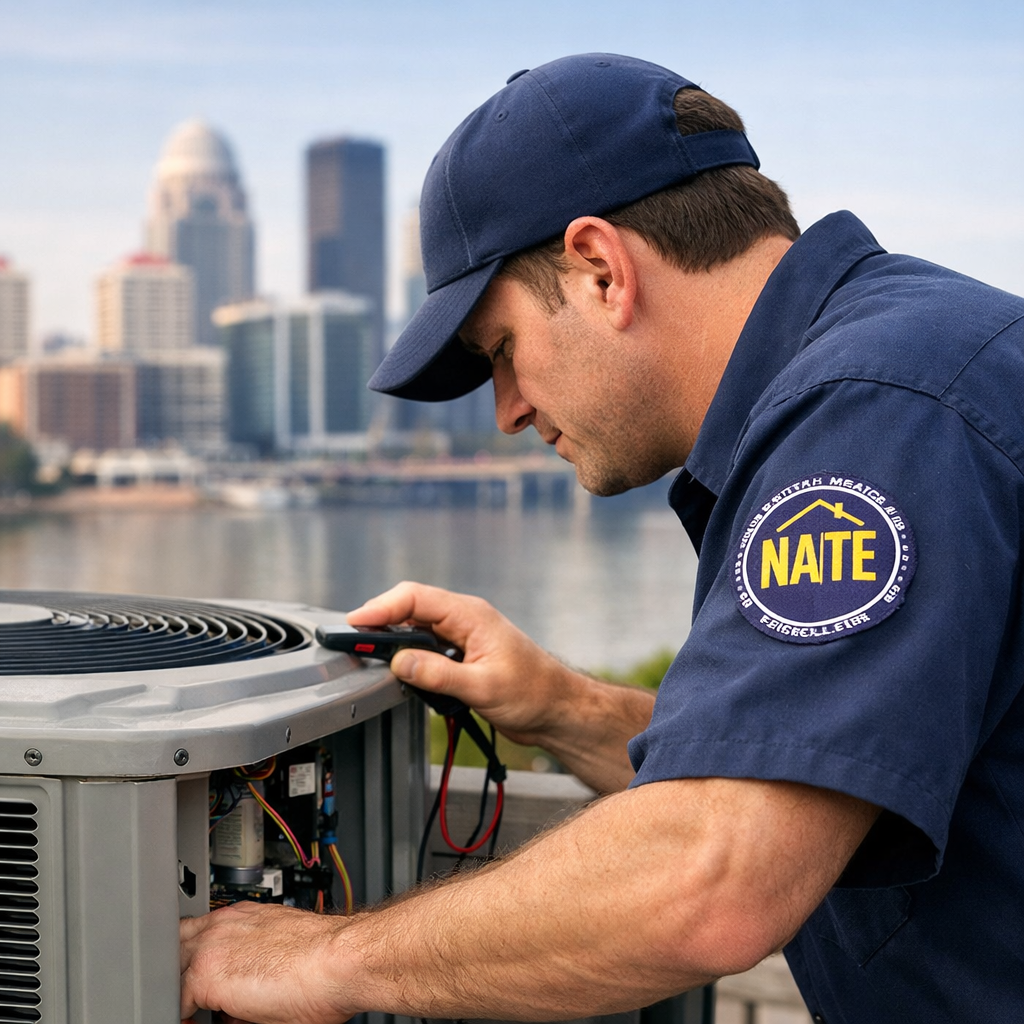
Need AC Help Fast? Find NATE-Certified Pros in Louisville, KY
When your AC quits during a Louisville heat wave, you need fast help from a proven pro—ideally a NATE‑certified HVAC technician who also holds a current Kentucky license and insurance. To find NATE‑certified HVAC contractors in Louisville, KY, ask the dispatcher for the onsite tech’s NATE ID, confirm their specialty matches air conditioning service, and verify Kentucky licensing and insurance before dispatch. Prioritize companies that provide itemized estimates and document test readings for code-compliant AC repair. The steps below show exactly how to verify credentials in minutes and book emergency AC repair Louisville KY with confidence. AC Repair Advisor’s quick checklists streamline each step so you can move from call to confirmation fast.
Why NATE certification matters for urgent AC service
NATE certification covers real‑world HVAC skills from installation to maintenance and troubleshooting, with specialties that include air conditioning, heating, gas furnaces, and refrigeration. It validates practical, field-ready competence that customers can verify through an ID and current card (source: NATE’s overview of certification benefits and scope at natex.org).
Employers prize NATE‑certified techs for higher accuracy and efficiency—advantages that translate into faster first‑pass fixes during summer emergencies (natex.org). NATE also promotes the credential as the HVAC “gold standard,” helping set expectations for professionalism and smoother service calls when time is tight (NATE’s public messaging via Facebook).
Diagnostic accuracy is the technician’s ability to identify the root cause of HVAC failures quickly and correctly. High accuracy lowers total repair time, prevents unnecessary parts changes, and minimizes repeat visits—especially critical during heat waves when parts availability and appointment windows are tight.
Louisville hiring essentials and compliance checks
Kentucky requires state‑issued HVAC licenses (not local‑only) with annual renewals due before the end of the licensee’s birth month. Licensees must complete six hours of approved continuing education each cycle, and typical renewal fees are $50 for journeymen and $250 for masters (Kentucky HVAC licensing summary via ServiceTitan).
Louisville’s talent pipeline benefits from accredited training and ongoing regional investments that expand the pool of trained technicians—often improving response times in peak season (industry training coverage in Today’s AC).
Compliance Quick Check
| What to verify | Why it matters | Proof to request | Where to check |
|---|---|---|---|
| Kentucky HVAC license (company/tech) | Legal compliance and code accountability | License number, name match, expiration date | Kentucky state licensing portal or license card |
| CE completion (6 hours) | Confirms current knowledge of code and best practices | CE certificate(s) for the current renewal cycle | Copy from licensee; course certificate |
| NATE certification and specialty | Signals job‑ready, tested skills for AC service | Tech’s full name, NATE ID, photo of current card with specialty and expiration | NATE registry or company dispatcher |
| General liability & workers’ comp | Protects you from liability for accidents/injuries | Certificates of insurance with policy limits and dates | Carrier‑issued COIs from the contractor |
How to verify a NATE-certified technician in minutes
- Ask for the technician’s full name and NATE ID.
- Request a photo of the current NATE card/certificate and listed specialty.
- Confirm the specialty aligns with your issue (e.g., air conditioning service).
- Cross‑check via the company dispatcher or NATE’s public registry if available.
- Save proofs to your job file for warranty and documentation.
NATE certification signals qualified, professional commitment recognized by employers and customers. NATE provides program guidance and credentialing—not product support—so verification should rely on the technician’s current credentials and the employer’s records. AC Repair Advisor consolidates these checks into a single, repeatable flow you can use before dispatch.
What to ask before you book emergency AC help
- Can you confirm your Kentucky HVAC license status and completion of the required six hours of CE for this renewal cycle?
- Is the onsite technician NATE‑certified? What is their specialty and expiration date?
- What is the estimated arrival window, and do you have likely parts on hand?
- Will you perform safety checks and an efficiency assessment during the visit?
- Can you provide a written, itemized estimate before work begins?
- Will diagnostics and repairs be commissioned with measurable tests (superheat/subcool, total external static pressure, voltage/amp draw, airflow)?
- What warranties or guarantees cover emergency repairs?
- Do you carry general liability and workers’ comp insurance, and can you share COIs?
- If the system is down, can you propose a safe temporary repair or interim cooling plan?
- How do you document findings and test data for my records?
AC Repair Advisor’s call script helps you capture these answers in one pass. Teams aligned to NATE training often coordinate dispatch and parts more effectively, improving turnaround during emergencies (Interplay Learning).
Expect test-backed diagnostics and code-compliant repairs
Commissioning is the process of verifying an HVAC system’s performance against design and code by measuring key parameters—refrigerant charge, airflow, electrical values, controls—and documenting results. Proper commissioning confirms safe operation, energy efficiency, and comfort before the job is considered complete.
NATE‑aligned training and hands‑on/simulation prep build the troubleshooting skills that improve on‑site accuracy and reduce callbacks (Interplay Learning). Some industry courses, such as evacuation and recovery classes, even carry NATE CE credits, reinforcing a culture of measurable, standards‑based work (AC Today, June 2024). AC Repair Advisor’s commissioning checklist mirrors the core tests below so you can ask for and file the readings.
Expect contractors to record:
- Refrigerant charge (superheat/subcool) against target values
- Total external static pressure and airflow benchmarks
- Electrical readings (voltage/amps), control operation, and safety limits
- Duct integrity and condensate management
When a repair becomes a replacement in Louisville homes
Use total cost of ownership—not the lowest upfront bid—to decide. Consider the factors below, then gather documented proposals for AC replacement Louisville.
| Factor | How to use it |
|---|---|
| System age | Near/over typical lifespan (10–15 years for many split systems) tilts toward replacement. |
| Repair cost threshold | If a repair exceeds ~40–50% of replacement cost, consider replacement. |
| Refrigerant type | Legacy R‑22 systems often justify replacement due to cost and availability. |
| Efficiency goals | New SEER2 systems can cut operating costs; compare savings vs. repair spend. |
| Comfort issues | Chronic humidity, hot/cold spots, or noise may signal right‑sizing needs. |
| Safety/code | Electrical, venting, or condensate violations warrant corrective scope or replacement. |
| Rebates/financing | Utility/market incentives can improve payback on high‑efficiency systems. |
A growing trained workforce and regional investments can improve install timelines, but demand spikes still create delays—start quoting early and require documented commissioning for code‑compliant installation. AC Repair Advisor prompts you to require documented commissioning and test data in every replacement quote.
How AC Repair Advisor helps you compare best-value quotes
Our unbiased, checklist‑driven method verifies KY licensing and CE, confirms NATE specialty alignment, and requires itemized scopes, test lists, and warranties—organized side‑by‑side so you can choose best value with confidence. We emphasize code‑compliant installs validated by measurable test data and commissioning results.
A fast 4‑step flow:
- Define comfort, efficiency, and budget goals.
- Gather at least three quotes with clear scopes.
- Validate credentials, required tests, and written warranties.
- Select the best‑value offer—not just the lowest price.
Get started with AC Repair Advisor for tools and guidance tailored to Louisville.
Red flags to avoid during peak heat waves
- No proof of Kentucky license, CE, or insurance upon request.
- Tech cannot show a current NATE credential or the correct AC specialty.
- Refusal to provide itemized estimates, test readings, or commissioning documentation.
- Over‑the‑phone diagnosis with pressure to replace immediately—no load calc or duct check.
- No clear emergency arrival window or parts plan during a heat wave.
Better options: ask for a safe temporary repair with basic efficiency checks, request an interim cooling plan, or schedule the earliest diagnostic with a written scope. AC Repair Advisor highlights these risks during our side‑by‑side review process.
Frequently asked questions
When should I schedule an AC tune-up in Louisville?
Schedule in spring, ideally March to early May, to catch issues early, improve efficiency, and reduce summer breakdown risk. AC Repair Advisor can remind you what to ask and verify with a simple pre‑season checklist.
What does a NATE-certified tech check during a service call?
Expect coil inspection/cleaning, refrigerant charge verification, thermostat calibration, filter and electrical checks, condensate clearing, and airflow or duct assessments with documented findings. AC Repair Advisor’s tune‑up checklist helps you confirm these items were measured and documented.
How do I confirm Kentucky HVAC licensing and insurance?
Ask for the state HVAC license number, proof of current renewal and six CE hours, and certificates of insurance; reputable firms provide these before dispatch or at arrival. AC Repair Advisor organizes these proofs so you can verify them quickly.
Do NATE-certified pros respond faster during emergencies?
Many teams with NATE‑certified techs maintain better training, dispatch coordination, and parts readiness, improving response times and first‑pass fixes. Use AC Repair Advisor to find and vet NATE‑certified pros fast.
What can I do before the tech arrives to speed diagnosis?
Clear equipment access, replace a dirty filter, note error codes or breaker trips, and list symptoms with times/noises; have model/serial numbers and past service records ready. AC Repair Advisor’s prep checklist keeps those details in one place.