Air-Source vs Geothermal Heat Pump Lifespan in Southern Indiana Explained
Air-Source vs Geothermal Heat Pump Lifespan in Southern Indiana Explained
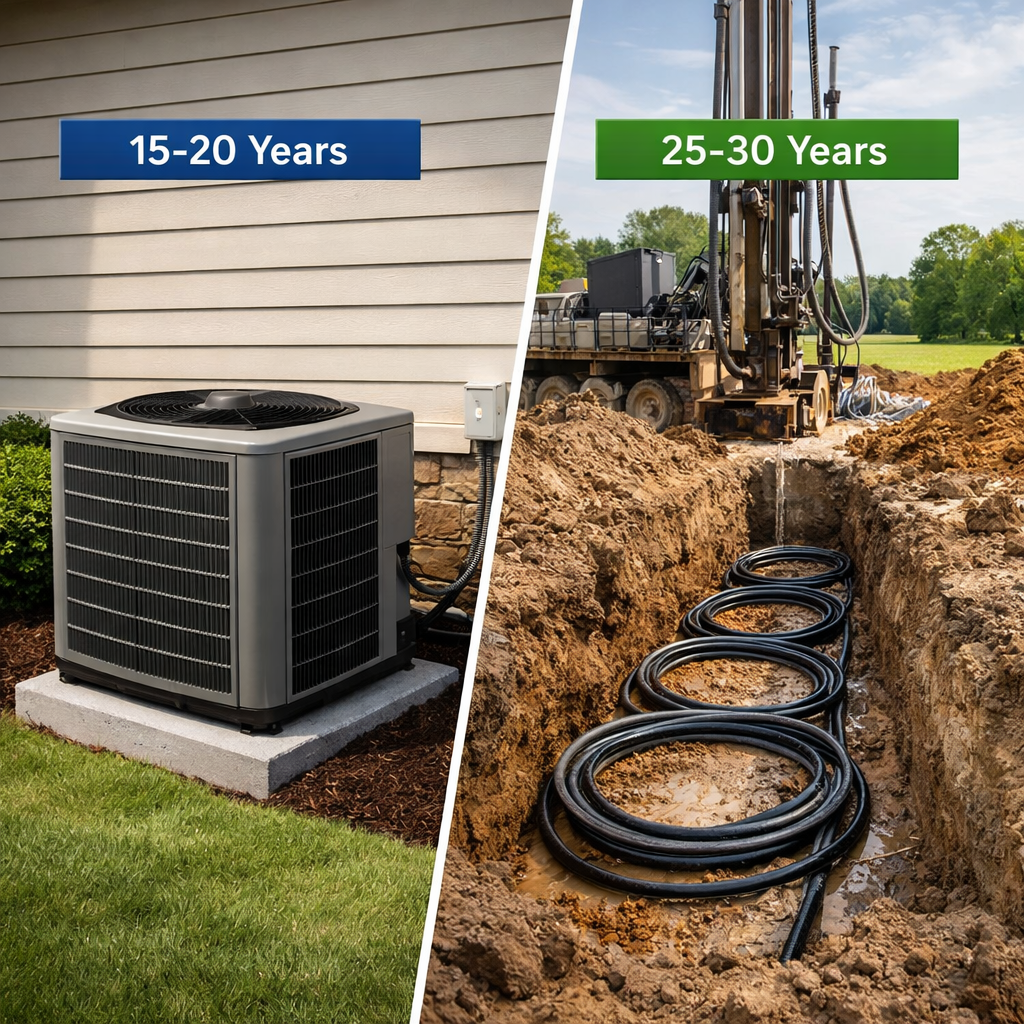
Southern Indiana’s humid summers and brisk, changeable winters are hard on outdoor HVAC equipment. If you’re deciding between an air-source heat pump (ASHP) and a geothermal/ground-source heat pump (GSHP), lifespan is a big part of the equation. In this region, air-source systems typically run 15–25 years, while geothermal indoor units often last 25–30+ years, with buried ground loops approaching 50 years when properly installed. The key difference is exposure: ASHPs live outdoors in the elements; most geothermal components live indoors or underground, away from weather and debris. Below, we break down how long these systems last here, what affects longevity, and how to make a smart, low-risk choice for your home. AC Repair Advisor helps Southern Indiana homeowners weigh longevity against cost and site conditions.
Lifespan at a glance
- Air-source heat pump (ASHP): 15–25 years typical in residential use, depending on installation quality, exposure, and maintenance, according to the EnergySage comparison of air-source and geothermal heat pumps. (EnergySage comparison)
- Geothermal/ground-source heat pump (GSHP): 25–30+ years for the indoor unit; ground loops can last up to roughly 50 years when designed and installed correctly (MrCool overview of geothermal vs air-source).
- Why the gap: Outdoor ASHP units face weather, corrosion, ice, and debris; geothermal keeps most components indoors/underground, operating against steadier temperatures with less weather wear (Geotherm HVAC guide to air-source vs geothermal).
Southern Indiana climate and what it means for longevity
An air-source heat pump moves heat to and from outdoor air—extracting heat in winter and rejecting heat in summer—so performance and runtime change with outdoor temperature and weather exposure (QuitCarbon comparison). A geothermal heat pump uses buried loops to tap stable ground temperatures for heating and cooling, keeping major components indoors and underground (Energy Saver: Geothermal heat pumps).
Because Southern Indiana sees humid summers, freeze–thaw cycles, and seasonal swings, ASHPs endure more stress from temperature extremes, moisture, and debris. GSHPs operate against steadier ground temperatures and are largely shielded from weather, which reduces cycling stress and physical wear. AC Repair Advisor accounts for these conditions when comparing system options for local homes.
Lifespan by system type
| System | Typical lifespan | Key longevity factors | Maintenance exposure |
|---|---|---|---|
| ASHP (outdoor + indoor) | 15–25 years | Weather exposure, install quality, maintenance cadence | Higher (outdoor coils, fins, fan, cabinet) |
| GSHP (indoor equipment) | 25–30+ years | Indoor location, stable operating temps, commissioning | Lower (mostly indoor components) |
| GSHP (ground loop) | Up to ~50 years | Loop design, soil conditions, installation quality | Very low once installed |
Takeaway: If you plan to stay long-term, geothermal’s longer average life and lower weather exposure can deliver stronger lifetime value. AC Repair Advisor can help validate whether your site fits geothermal economics.
Air-source heat pump lifespan range
Expect 15–25 years for a well-installed ASHP, with the low end more likely when outdoor units face corrosion, icing, and debris without protection or regular service (EnergySage comparison; Geotherm HVAC guide to air-source vs geothermal). Ducted and ductless options offer retrofit flexibility—useful in older homes—though access for maintenance and the quality of existing ducts can influence outcomes (QuitCarbon comparison).
Geothermal heat pump lifespan range
Indoor geothermal units commonly run 25–30+ years because they operate in a sheltered environment and work against steady ground temperatures, reducing wear and noise (Geotherm HVAC guide to air-source vs geothermal; Energy Saver: Geothermal heat pumps). Despite higher upfront cost, their efficiency often lowers annual operating costs, supporting longer ownership horizons.
Ground loop longevity
Properly installed ground loops can last up to about 50 years (MrCool overview of geothermal vs air-source). A geothermal ground loop is a buried piping network circulating a water-based solution to exchange heat with the earth’s stable temperature for heating and cooling. Loop failures are rare, but underground repairs are more complex and costly than typical ASHP fixes—another reason to prioritize quality design and experienced installers.
What shortens or extends heat pump life
Four high-impact drivers determine whether systems reach the top of their lifespan range:
- Installation quality and correct sizing
- Exposure to weather and site conditions
- Maintenance routines and filter care
- Runtime, controls, and power quality
Installation quality and sizing
Proper load calculations (Manual J or equivalent), duct/loop design, and commissioning are foundational. For GSHPs, loop design and soil/water table assessments prevent stressed equipment and underperformance. AC Repair Advisor recommends verifying credentials and comparing apples to apples scopes (load calcs, model numbers, loop lengths) before signing.
Do this vs. watch out for this:
- Do this: Require Manual J and a commissioning checklist; ask for loop design details (type, depth/length).
- Watch out for this: Rule-of-thumb sizing, missing design notes, or vague proposals with no testing/verification.
Exposure to weather and site conditions
Outdoor ASHP units face corrosion, snow/ice, and debris; elevate on pads, add snow shields where needed, and keep clearances open to extend life (Geotherm HVAC guide to air-source vs geothermal). Geothermal equipment is typically indoors or underground, reducing weather wear and noise (Energy Saver: Geothermal heat pumps). For GSHPs, careful trenching/boring and utility locates reduce risk of future loop issues.
Do this vs. watch out for this:
- Do this: Place ASHPs above snow lines; ensure 2–3 feet of clearance; plan GSHP loop paths to avoid future digging conflicts.
- Watch out for this: Units under roof drips or dense shrubs; unprotected coastal/corrosive exposures; poorly mapped loop fields.
Maintenance routines and filter care
Schedule annual professional service for all heat pumps. ASHPs often need more outdoor coil cleaning due to exposure. In general, ASHP maintenance and repairs are simpler and cheaper than addressing geothermal loop problems, which are rare but specialized (Sealed comparison of air-source vs geothermal). Homeowner habits—monthly filter checks, seasonal debris clearing, and vegetation control—have outsized impact on lifespan.
Do this vs. watch out for this:
- Do this: Monthly filter checks; spring/fall cleanings; verify condensate drains.
- Watch out for this: Dirty filters, blocked coils/fins, and ignored service intervals.
Runtime, controls, and power quality
Modern inverter ASHPs modulate output to reduce cycling stress and lower inrush current; paired with smart thermostats and gentle setpoint changes, they protect compressors and improve comfort (Green Building Advisor on inverter vs GSHP). Surge protection and stable voltage further reduce premature failures.
Do this vs. watch out for this:
- Do this: Choose inverter-driven models; enable gradual setpoint schedules; install whole-home surge protection.
- Watch out for this: Oversized single-stage units, aggressive setback swings, frequent power interruptions.
Cost, efficiency, and lifetime value
To compare systems on equal footing, use a simple lifetime value view: upfront cost minus incentives + a 10-year energy estimate + expected maintenance/repairs. Incentives and energy savings can materially shift payback timelines. AC Repair Advisor uses this framework to keep decisions clear and comparable.
Upfront cost ranges and incentives
Typical installed costs: ASHPs roughly $4,500–$25,000 (some sources cite $3,500–$20,000), and GSHPs roughly $8,000–$30,000, depending on size, duct/loop work, and controls (Palmetto overview). Many heat pumps qualify for incentives, including a 30% federal tax credit for geothermal systems; ask contractors to itemize expected incentives in written quotes (MrCool overview of geothermal vs air-source).
Operating efficiency and seasonal performance
Heat pump efficiency is described by COP: moving 3 units of heat per 1 unit of electricity equates to roughly 300% “effective efficiency.” Air-source commonly achieves around that level; geothermal can reach up to about 600% in ideal conditions and often performs 20–40% more efficiently than air-source in colder weather, trimming annual operating costs (Palmetto overview). Compare seasonal performance with local electricity rates and your thermostat habits.
Repairs, parts, and warranty considerations
ASHP repairs are usually simpler and less costly because there’s no buried loop, whereas GSHP loop issues are rare but more expensive and specialized (Sealed comparison of air-source vs geothermal). Request written parts and labor warranties, loop warranties, and maintenance-plan terms. Track manufacturer vs. installer coverage separately, noting that variable-speed components may have different warranty periods.
Maintenance differences homeowners should expect
- ASHP focus areas:
- Outdoor coil/fins cleaning, vegetation clearance, snow/ice protection
- Fan motor and cabinet condition, refrigerant checks, electrical tests
- GSHP focus areas:
- Indoor unit inspection, loop fluid quality and pressure, circulator pumps
- Controls and thermostat verification; minimal outdoor cleaning
Annual service tasks and intervals
- Annual professional tasks: refrigerant and electrical checks; ASHP coil cleaning; GSHP loop fluid and pump checks; thermostat/controls verification.
- Seasonal timing: target spring and fall tune-ups to bracket peak loads in Southern Indiana.
- Expect fewer weather-related cleanings for geothermal because equipment is indoors/underground (Energy Saver: Geothermal heat pumps).
Homeowner checklist to extend service life
- Monthly: check/replace filters; maintain 2–3 feet of clearance around ASHPs; clear leaves and grass clippings.
- Seasonal: gently rinse ASHP coils/fins; verify condensate drains; review thermostat schedules to prevent short cycling.
- Annual: schedule a pro inspection; for GSHPs, confirm loop pressure and fluid quality.
Repair or replace thresholds
Use a simple three-step approach:
- Identify symptoms (noise, lockouts, rising energy use, capacity loss).
- Get repair and replacement estimates with scope in writing.
- Apply age/efficiency thresholds to decide whether to invest or replace. Always get at least two detailed quotes to validate pricing and scope.
Signs a system is nearing end of life
Frequent lockouts, compressor or fan noise, reduced capacity during severe weather, rising kWh for the same comfort, and refrigerant leaks suggest aging components. For ASHPs, cabinet corrosion, bent fins, and failing fan motors are common late-life issues (Geotherm HVAC guide to air-source vs geothermal).
The 50 percent rule and age benchmarks
If a repair exceeds 50% of replacement cost and the unit is beyond midlife (ASHP around 10–12 years; GSHP indoor unit 15+ years), replacement usually makes financial sense. Include expected utility savings and current incentives in the math to reflect true total cost of ownership (MrCool overview of geothermal vs air-source).
Choosing the right path for Southern Indiana homes
| Factor | Air-source heat pump (ASHP) | Geothermal heat pump (GSHP) |
|---|---|---|
| Time in home | Short/uncertain timelines | Long-term ownership (10–20+ years) |
| Lot size/soil | Minimal yard impact | Needs loop space and suitable soil/water table |
| Upfront budget | Lower to moderate | Higher (offset by incentives/operating savings) |
| Installation speed | Faster | Longer due to loop design/installation |
| Noise preferences | Outdoor fan/compressor present | Very quiet indoors; no outdoor condenser |
| Maintenance appetite | Regular outdoor cleaning/clearance | Lower day-to-day upkeep post-install |
Summary: If you’re budget-conscious, space-limited, or need a fast retrofit, an ASHP is the practical choice. If you’ll be in the home long-term and your lot suits a loop field, geothermal’s efficiency, quiet operation, and longer component life can pay off over decades. AC Repair Advisor can help you test both paths against your home and budget.
When air-source is the practical choice
- Limited yard space, lower upfront budget, faster installation, or phased electrification (often with inverter ASHPs and solar).
- Ducted or ductless options simplify retrofits in existing homes. With proper sizing and maintenance, 15–25 years of service is realistic.
When geothermal is the better lifetime investment
- You expect to stay long-term, have suitable lot/soil conditions, and can accept higher upfront cost for efficiency and longevity.
- Benefits include lower annual operating costs, very quiet operation, and the potential for heating, cooling, and domestic hot water from one system. Loops can last around 50 years, supporting multi-decade value.
How AC Repair Advisor helps you pick and vet installers
- Build a local shortlist
- Identify 3–5 contractors with verifiable ASHP/GSHP experience via utility lists and local directories.
- If considering GSHP, prioritize firms with documented drilling partners.
- Analyze review patterns for authenticity and consistency
- Look for recurring strengths in commissioning and post-install support.
- Beware bursty reviews or rating declines after warranties expire.
- Verify licenses and insurance
- Confirm state/county HVAC licensing, geothermal loop certifications, and active liability/workers’ comp.
- Request certificates and verify with issuing bodies.
- Compare quotes and scope apples to apples
- Require itemized proposals with model numbers, tonnage, loop type/length, permits, and incentives.
- Insist on load calculations, duct/loop design notes, and commissioning checklists.
- Check availability and responsiveness
- Track response times and clarity; ask about emergency coverage and parts stocking.
- Review warranties and maintenance plans
- Compare parts/labor terms, loop warranties, and maintenance intervals; clarify who handles incentive paperwork.
- Confirm final scope and pricing in writing
- Lock in permits, installation methods, disposal, commissioning, and homeowner training; tie payments to milestones and itemized incentives.
Build a local shortlist
Identify 3–5 Southern Indiana HVAC contractors with proven ASHP/GSHP projects, and ensure geothermal bidders have established drilling partners.
Analyze review patterns for authenticity and consistency
Favor contractors with consistent praise for workmanship and commissioning across years; be cautious of template-like reviews or post-warranty drop-offs.
Verify licenses and insurance
Confirm active HVAC licenses, geothermal certifications, and liability/workers’ comp coverage; obtain and verify certificates before site visits.
Compare quotes and scope apples to apples
Standardize proposals with model numbers, sizing (Manual J), duct/loop designs, commissioning steps, permits, and line-item incentives to prevent scope gaps.
Check availability and responsiveness
Note response and scheduling times, clarity of technical answers, emergency service policies, and parts availability for your shortlisted models.
Review warranties and maintenance plans
Compare written parts/labor durations, loop warranties, maintenance schedules, and who processes rebates/tax-credit paperwork.
Confirm final scope and pricing in writing
Execute a signed scope covering permits, methods, disposal, commissioning, and homeowner training; align milestone payments and itemized incentives in the contract.
Frequently asked questions
How long do heat pumps usually last in Southern Indiana’s weather
Air-source heat pumps typically last about 15–25 years, while geothermal indoor units often run 25–30+ years and ground loops up to roughly 50 years because outdoor exposure makes ASHPs more vulnerable to weather-related wear. AC Repair Advisor can help estimate where your home will fall based on site conditions.
Why do geothermal systems tend to last longer than air-source
Most geothermal components are indoors or underground, avoiding weather, debris, and corrosion. AC Repair Advisor uses this difference when advising local homeowners.
Can modern cold-climate air-source models match geothermal longevity
Cold-climate inverter ASHPs can narrow the gap by smoothing operation and reducing cycling, but they still live outdoors, so geothermal generally retains a longevity edge. AC Repair Advisor can help compare models for your site.
What maintenance has the biggest impact on lifespan
Annual professional service, clean filters, and keeping the outdoor unit clear of debris matter most for ASHPs; for geothermal, yearly checks of loop fluid, pumps, and controls preserve long, efficient operation. AC Repair Advisor can help you set a simple maintenance plan.
How do incentives affect total cost of ownership over a system’s life
Incentives—often including a 30% federal tax credit for geothermal—reduce upfront cost and accelerate payback; ask contractors to include incentive estimates in written quotes or work with AC Repair Advisor to verify them.