24/7 Emergency HVAC Repair in KC: Fast, Reliable Options
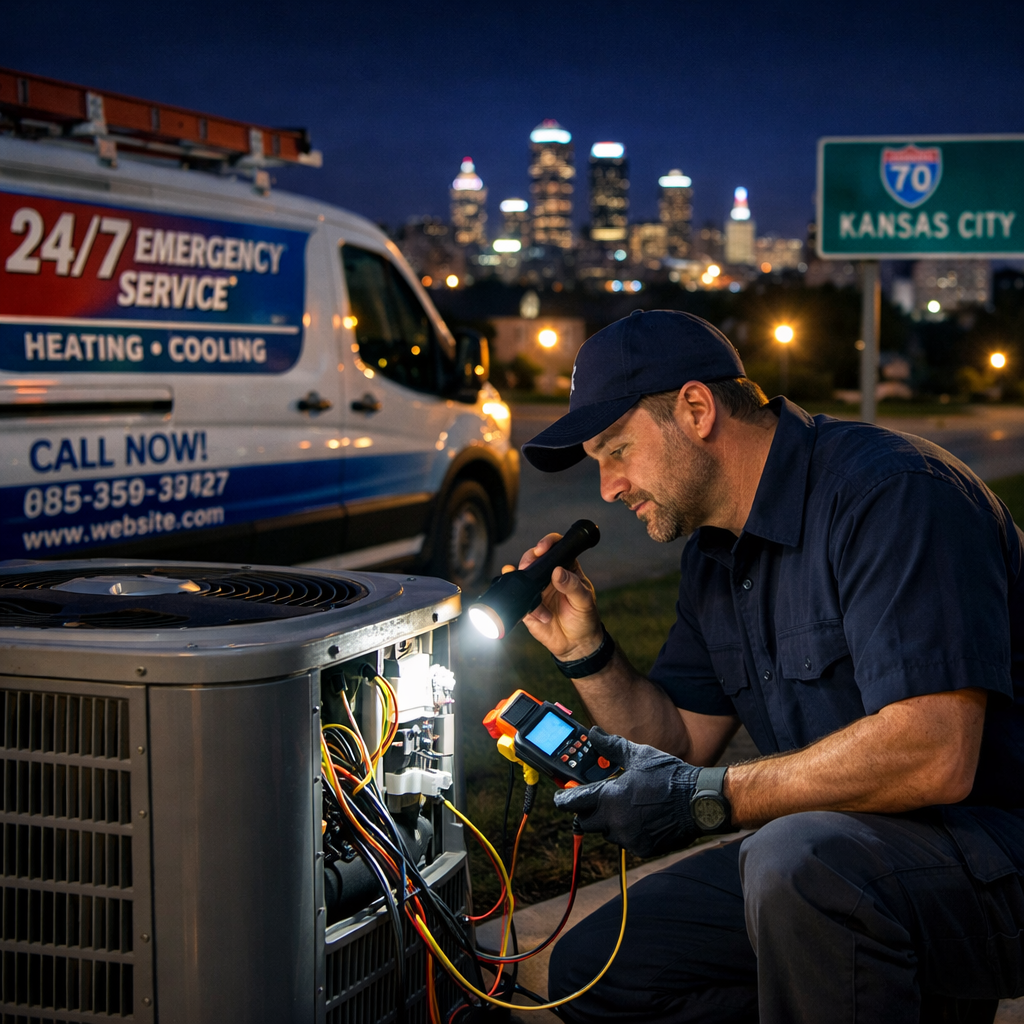
24/7 Emergency HVAC Repair in KC: Fast, Reliable Options
When your heat dies on a subfreezing KC night or your AC quits during a heat wave, you need same-day HVAC service in Kansas City—not a waiting list. This guide from AC Repair Advisor shows you what counts as an HVAC emergency, the safest immediate steps, what services are truly available 24/7, and how to choose a reliable provider fast. We include real-world response patterns, cost ranges, and red flags to help you avoid callbacks. If you’re scanning for help now, start with AC Repair Advisor to vet options quickly; providers like Summit, ABMay, and Anthony publicly advertise round-the-clock coverage, rapid dispatch, and emergency triage across the metro, with options to stabilize first and complete repairs after daylight using stocked parts trucks (see provider references below).
What counts as an HVAC emergency in KC
An HVAC emergency is a sudden failure or hazardous malfunction of heating, cooling, or ventilation that risks safety, property damage, or health—especially during extreme temperatures. It includes gas leaks, electrical failures, or complete loss of heat/cooling requiring immediate, professional attention.
Common KC examples include a furnace that won’t turn on, blows cold air, or makes grinding/booming noises, all of which signal urgent issues that can worsen with use, as highlighted on ABMay’s emergency heating page. Electrical failures that trip breakers or spark should be treated as safety risks requiring shutdown and professional diagnostics, consistent with guidance in the rapid-response HVAC overview. Refrigerant leaks slash cooling output and can damage compressors if ignored, another scenario where fast intervention matters, per the same rapid-response resource.
Quick emergency checklist for KC homeowners:
- No heat during subfreezing temps, or no AC during severe heat
- Smell of gas near furnace or water heater
- Repeated breaker trips or sparking at the unit
- Refrigerant/oil stains or hissing at AC lines
- Water heater leaks or no hot water (many 24/7 teams include water heaters; see All Hours 24/7 services)
Immediate steps to stay safe and prevent damage
If you smell gas, shut off the furnace, avoid any ignition sources or sparks, evacuate, and call for help immediately. If you see sparking or experience repeated breaker trips, cut power to the equipment at the disconnect or breaker and wait for a technician, as advised in the rapid-response HVAC overview.
In winter, protect against frozen pipes by opening cabinet doors and allowing faucets to drip in unheated zones; in summer, safeguard vulnerable occupants and critical electronics if indoor temps climb—speed matters for health and property, a theme echoed in the rapid-response guidance above.
Mini step-by-step flow while you wait:
- Identify the main symptom and any safety red flags.
- Shut down the system if there’s sparking, burning smells, or suspected gas.
- Check basics: thermostat settings and filter.
- Document error codes, smells, and noises; take photos.
- Clear access to equipment and the electrical panel.
- Call a 24/7 provider, describe symptoms succinctly, and follow their triage instructions.
Services typically available 24/7 in Kansas City
Most emergency teams offer after-hours diagnostics and repair for heating and cooling, plus water heater emergencies such as leaks or no hot water (see the scope on All Hours’ 24/7 page). Coverage typically spans residential and commercial equipment—including rooftop units and all major brands—handled by cross-trained techs with on-truck parts. For fast screening, use AC Repair Advisor’s checklist below; multiple KC providers advertise true 24/7 dispatch and availability, including Summit Heating & Cooling’s emergency service, ABMay’s emergency heating, and Anthony’s emergency services.
What to look for after-hours:
- Immediate intake via phone or online, with clear ETAs
- Fully stocked trucks to enable one-visit fixes or safe temporary stabilization
- Cross-brand expertise and rooftop/commercial capability where needed
- Transparent guidance on whether a same-night patch or next-day full repair is best
Typical 24/7 coverage in KC:
| Service type | 24/7 availability in KC | Typical first fixes | When it escalates |
|---|---|---|---|
| Heating (furnace/boiler) | Yes | Ignition/limit checks, sensor cleaning, relight | Heat exchanger failure → replacement review |
| Cooling (AC/heat pump) | Yes | Refrigerant leak find/temporize, capacitor/fan | Compressor failure → major repair/replace |
| Water heaters | Yes | Shutoff/contain leak, relight, valve/thermostat | Tank breach → replacement |
| Rooftop/commercial | Yes (provider-specific) | Belt/capacitor/fan swaps, control resets | Coil/compressor issues → staged repair plan |
| Electrical diagnostics | Yes | Breaker/contactor checks, safe de-energizing | Wiring or panel defects → licensed repairs |
What to expect during an emergency visit
The standard flow starts with safety triage—checking for gas leaks, electrical hazards, and ventilation issues—followed by diagnostics, a clear explanation of options, and an upfront estimate before work begins. Providers like Summit’s emergency service page emphasize transparent approvals and communication.
Expect technicians to protect your home with floor coverings or booties and to remove waste. Quality teams aim for lasting repairs, not band-aids that lead to callbacks, a best-practice echoed in the rapid-response overview. Many KC trucks carry common parts to complete same-visit fixes and can support commercial/rooftop equipment, aligned with All Hours’ 24/7 scope. This transparency- and quality-first approach aligns with AC Repair Advisor’s guidance throughout this guide.
Typical emergency HVAC costs and pricing factors
Across Kansas City, typical HVAC labor rates run about $89–$190 per hour, minor repairs often land under $500, major component swaps can exceed $1,000, and a full furnace replacement averages around $6,518 locally, according to the KC cost overview on Modernize. After-hours premiums may apply on nights, weekends, and holidays.
Many companies charge a diagnostic fee that’s waived or credited if you proceed with recommended repairs; getting a written, line-item estimate with no hidden fees is a reliable transparency signal, as reflected on Summit’s emergency page.
Cost snapshot by issue:
| Issue type | Typical parts/labor scope | Potential after-hours premium | When replacement is more cost-effective |
|---|---|---|---|
| Ignition failure | Sensor/ignitor replacement, cleaning, tuning | +$50–$200 | Cracked heat exchanger or obsolete furnace |
| Blower motor | Capacitor or motor swap, balance/airflow check | +$75–$250 | Repeated motor failures on very old systems |
| Thermostat | Recalibration or replacement | Minimal to none | Rare—only with system-wide upgrades |
| Refrigerant leak | Leak locate, repair, recharge where allowed | +$75–$250 | Large coil/compressor failures on aging AC |
Note: Actual pricing varies by brand, part availability, system age, and warranty status.
How to choose a fast, reliable KC emergency provider
Prioritize teams that:
- Publicly advertise 24/7 coverage with rapid dispatch across the metro (see Summit’s emergency service, ABMay’s emergency page, and Anthony’s emergency services).
- Arrive in stocked trucks to maximize one-visit fixes (aligned with All Hours’ 24/7 capabilities).
- Provide written, upfront estimates, emphasize no hidden fees, and use quality parts (reinforced by Summit’s transparency).
Quality signals to seek:
- Documented experience, certifications such as NATE, and ongoing training (noted on Anthony’s emergency page).
- Financing or homeowner plans for larger jobs (see options on ABMay’s emergency page).
- Pre-identify a contractor ahead of peak seasons; locals report faster responses for known customers during crunch times, a pattern echoed in this Kansas City Reddit thread.
Start with AC Repair Advisor’s checklist below to move from first call to a firm ETA with fewer surprises.
AC Repair Advisor’s rapid contractor screening workflow
Use this six-step, repeatable check—built to minimize risk under time pressure:
- Confirm true 24/7 coverage and real-time availability. Ask for tonight’s ETA range before sharing payment info.
- Cross-check ratings and complaint histories (BBB, Google). Prioritize reviews with photos and detailed timelines.
- Verify licensing and insurance; ask if the company employs NATE-certified techs and invests in continuing education.
- Ask about truck stock and parts-on-hand for your brand; request the technician’s same-day repair probability.
- Require a written, line-item estimate with warranty terms; confirm diagnostic credits and no hidden after-hours fees.
- Save proof-of-work photos, replaced parts, and service notes. File them with your warranty and model/serial records.
Keep this checklist handy at home and share it with household decision-makers so anyone can act confidently in a pinch. For more consumer-first guidance, see AC Repair Advisor’s main hub at https://acrepairadvisor.com/.
Trusted sources to verify KC contractor quality
Cross-check quickly before you commit:
- Ratings and complaint databases: Look for patterns (missed ETAs, repeat fixes, messy workmanship) supported by photos or manager responses.
- Company training pages: Seek references to continuous training and NATE-certified technicians, similar to what’s noted on Anthony’s emergency services page.
NATE certification is a widely recognized HVAC technician credential that verifies knowledge of installation and service standards across heating, cooling, and ventilation systems. Certified techs pass rigorous exams, signaling competence, safety awareness, and up-to-date practices—useful when choosing providers for complex or emergency repairs. Use the quick verification matrix below to speed this step.
Quick verification matrix:
| Source type | What to look for | Action to take |
|---|---|---|
| Ratings | Recent reviews with photos, consistent 4.5+ trend, manager responses | Call top-rated two; confirm 24/7 ETA and pricing transparency |
| Complaints | Repeated themes: no-shows, surprise fees, warranty disputes | Ask provider how they prevent these; get terms in writing |
| Training | Mentions of NATE, apprenticeships, ongoing education | Request the assigned tech’s certification and experience |
Red flags to avoid during urgent hires
- No written estimate, vague labor rates, or refusal to disclose after-hours fees.
- No stocked parts; pushing immediate system replacement without diagnostics or photos.
- Safety shortcuts (no booties, no waste removal) and unwillingness to discuss warranties—behavior at odds with the transparent approach shown on Summit’s emergency page.
If a quote sits far outside typical KC ranges, pause and get a second opinion, using the KC cost baselines on Modernize as a gut check.
Preparing ahead for peak-season emergencies
- Pre-identify a 24/7 contractor and store the number on your fridge and phone; during extreme weather, KC homeowners report tighter availability for first-time callers in the local Reddit thread.
- Schedule preseason maintenance and safety checks; confirm parts availability for your brand and age of equipment.
- Build a home emergency kit: space heaters or fans, pipe insulation, spare thermostat batteries, and a printed vendor list.
- Keep a short, printable system sheet: model/serial numbers, filter sizes, warranty status, and past repair notes. Consider printing AC Repair Advisor’s screening checklist and storing it with this sheet.
Frequently asked questions
Is 24/7 HVAC repair truly available at night, weekends, and holidays in KC
Yes. Multiple KC providers advertise 24/7 emergency coverage for heating, cooling, and water heater issues; availability tightens during peak weather—use AC Repair Advisor’s checklist to confirm real-time ETAs.
How fast can a technician realistically arrive during extreme weather
Response times vary, but many companies offer rapid dispatch with same-day or overnight service; calling with AC Repair Advisor’s symptom notes can speed triage.
Do emergency calls cost more than standard service visits
Often yes. After-hours premiums and higher labor rates can apply—get a written, line-item estimate and confirm any diagnostic credit as AC Repair Advisor recommends.
Should I shut off my system if I smell gas or see sparking
Yes. If you smell gas, turn off the furnace, avoid ignition sources, evacuate, and call for help; for sparking or tripping breakers, cut power and then follow AC Repair Advisor’s safety steps above.
Do I need a membership or plan to access after-hours service
Not always. Many KC providers take emergency calls from all customers, while plans may offer priority—AC Repair Advisor suggests asking about eligibility and response windows.